
- Athletics
- Students
- Academic
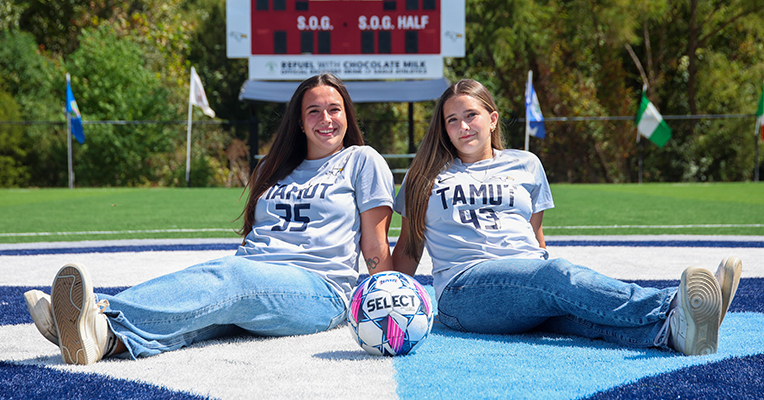
“I started playing when I was three. It’s always only been soccer for me,” — Faith “Rae” Wylie
Rae and sister Ella Wylie’s mother played soccer for Texas A&M University, so she naturally encouraged her girls to play at a young age. “As soon as I was able to walk, my parents said, ‘Here, have a soccer ball,” A&M Texarkana freshman Ella shared.
Their mom developed degenerative hearing loss in her thirties, yet both girls passed newborn screenings. “Whenever I was younger, my coping mechanism was to just be goofy and play it off if I didn’t hear something,” Rae shared. But her mom knew she wasn’t faking, and at four years old, Rae was also diagnosed with progressive hearing loss. “My speech was a bit behind. That’s the whole reason my mom noticed, because of how I would say things weird or not respond.”
Ella was only six months old at the time, yet her mom insisted on having her hearing tested too. “I got my first hearing aids by 12 months,” Ella shared. “The older I got, the more I realized how important it was that this is part of my identity and this is part of who I am.”
Growing up with that shared experience and a shared love of soccer also shaped their relationship as sisters. Ella shared, “I think we’ve gotten closer as we’ve gotten older. We have a unique sisterly relationship, I think, growing up playing soccer together.” Rae added, “I wanted to make sure we set boundaries so that she didn’t feel like she was in my shadow. We’re Ell and Rae, not ‘Oh, that’s Rae’s little sister.’”
Playing on the A&M Texarkana women’s soccer team together almost wasn’t part of their story. Rae graduated high school in 2022, in the height of COVID affecting recruiting. “Schools weren’t taking many freshmen. So, finding a school was really hard, especially finding one that had engineering,” Rae confessed.
She ultimately attended a junior college in Oklahoma, playing soccer there for two years. “I lot of people ask, ‘You went to a JUCO?’ and I’m like, ‘Yes, I went to a JUCO!’ I got to play and start for two years. I have lifelong friends from there.”
While soccer shaped where Rae went to college, engineering shaped what she was looking for in a school. Rae and Ella’s grandfather was a developer, so Rae grew up on job sites, collecting rocks and shells, and drawing blueprints for a dream tree house, foreshadowing her future interest in civil engineering. “I didn’t go for an associate’s degree in junior college,” Rae explained. “I went for classes that set me up for a four-year degree, like physics, calculus, and chemistry. Then, I was recruited to play Division II soccer at Lincoln University in Missouri.”
Her junior year, Rae played every game. “That spring, I got injured and it wasn’t a small injury. I was diagnosed with exertional compartment syndrome. It’s probably one of the hardest recovery processes.”
Yet, Rae was determined. She had a team to make. “I played for the national women’s deaf soccer team as well and we were going to Japan, and my goal was to be on that roster. So, I sped through my recovery,” Rae shared. “I did the whole process. I got back. I played the last 10 minutes of one game, right before conference started my senior year.”
And then, appendicitis hit. “If that’s not God saying it’s not your time, then I don’t know what is.” Due to her faith, Rae wasn’t stressed—even after receiving a medical waiver and being redshirted her senior year. “I knew it was God.”
That’s when A&M Texarkana enters her story. “Through a lot of prayer I knew I’d spend my fifth year somewhere else,” Rae shared. “I think I needed to be rerouted somewhere else to grow where I need to be. I came on a visit, and I loved it, and the soccer team is good!”
Ella’s path to A&M Texarkana came with its own unexpected turns. “I didn’t really get super serious about wanting to be good at soccer until probably high school,” Ella confessed.
As a sophomore, Ella’s parents allowed her to go to Malaysia for Rae to compete in the Women’s Deaf National Team World Cup. “It was my first real experience being around deaf sports and it was a big turning point for me. I saw what deaf athletes look like and what that team environment looks like. I knew this was something I really wanted to do. That’s when I knew I had to lock in. When I started playing for passion, it became more about ‘what do I have to do to make myself better.’”
Her junior year of high school, she experienced shoulder pain that progressively got worse. “I think we saw 8 to 10 doctors, and nobody knew what was going on with my shoulder. I still kept playing. It was just hard and uncomfortable.”
Ella eventually saw a surgeon who diagnosed her with vascular thoracic outlet syndrome. “He told me I could have surgery or continue playing, but there were risks involved, so I made the decision to have surgery. I also had no idea where I was going to be in August and I was about to graduate in three months,” she confessed. “I was still trying to find the right school for me, and I was looking for a specific major.”
That specific major grew from an interest that started years earlier. Ella grew up watching “Criminal Minds” in middle school. “I thought I’m going to be a criminal profiler. That was kind of my foot in the door to criminal justice.”
She also remembers wanting to be an archeologist. “I wasn’t interested in pottery or vases— I was interested in the ancient burial sites.”
Offering family members closure after tragedy is Ella’s motivation in pursuing criminal justice and her specific interest in forensic anthropology (think “Bones”). “I want to be the person to give them a name and be able to tell what happened to them. Even if they were murdered 50 years ago and they just found their remains, I want to be able to put a story together and give the family back that dignity,” Ella explained.
She visited many colleges, even with surgery looming. “What really set A&M Texarkana apart was their forensic biology pathway. I also loved the campus. This felt like somewhere I could see myself staying for a long time,” Ella shared.
Now, the Wylie sisters have the unexpected opportunity to play on the same collegiate team. “We’re our own people. We’re our own players,” Ella shared. “We just enjoy each other’s company and happen to be blood related.” Rae added. “Whenever we weren’t playing on the same team, I knew her goal was to play in college, so I would give her constructive criticism. Now that we play on the same team, I can just be her cheerleader. We bring out confidence in each other.”
That confidence stems further than the soccer field. “We’re both female and in STEM,” Rae shared. Ella emphasized, “We’re disabled women in STEM.” Rae continued “There’s times when we’ll rant and then there’s times where we just have to lock in.”
For other young women considering STEM fields or balancing a disability, Rae encourages, ‘Hey you can do this. You can be doctors. You can be engineers. You can be professional soccer players.’” With plenty of grit and spunk, Ella adds, ‘Watch me, I’ll show you.’”
If Rae or Ella’s interests resonate with you, check out A&M Texarkana’s Bachelor of Science in Civil Engineering or Bachelor of Science in Criminal Justice programs.